
Summit City Directory Holdings
Summit has several historical directory paths, but none should be treated as one unbroken annual run. The Summit Historical Society says its city-directory holdings date back to 1890, while the exact year-by-year run has not been published online. Digitized Price & Lee volumes establish 1938 and 1956 directly. The Union Public Library describes a regional City Directories collection for 1942 through 2012, but a regional collection description does not prove that every listed year contains a Summit section. Title pages and municipality headings matter.
| City Collection | Years | Where Held | Access |
|---|---|---|---|
| Summit city directories | Dating back to 1890; exact annual run incomplete | Summit Historical Society | Ask for a title and year; appointment or onsite research |
| Price & Lee regional directories | 1938 and 1956 directly identified | Union Public Library Digifind | Free digitized scans, with title-page and municipality checks |
| Regional City Directories collection | 1942-2012 described regionally | Union Public Library Digifind | Inspect each item before calling it a Summit volume |
| Selected Summit-area directories | 1928-1930, 1932, and 1934 | National Archives catalog context | Use the catalog lead to locate the relevant volume |
The collection is a historical shelf, not a live roll. The 1938 and 1956 books combine Summit with Millburn and Springfield, and the same care applies to any regional scan. Check the heading on the actual page before assigning an entry to Summit. A missing name may reflect a gap, a canvass choice, a spelling change, or a different municipal section.
Summit Historical Society Sources
The Summit Historical Society is the main local archival lead for city directories, house files, genealogy files, tax atlases, maps, newspapers, photographs, postcards, and yearbooks. It is based at the Carter House, 90 Butler Parkway. Its listed regular hours are September through June, Tuesday 9 to noon and Wednesday 1 to 4, with appointments otherwise; July and August are by appointment. Verify the schedule before a visit and ask whether a surname, address, organization, or directory year appears in a finding aid.
View the Historical Society archive before arranging a visit.
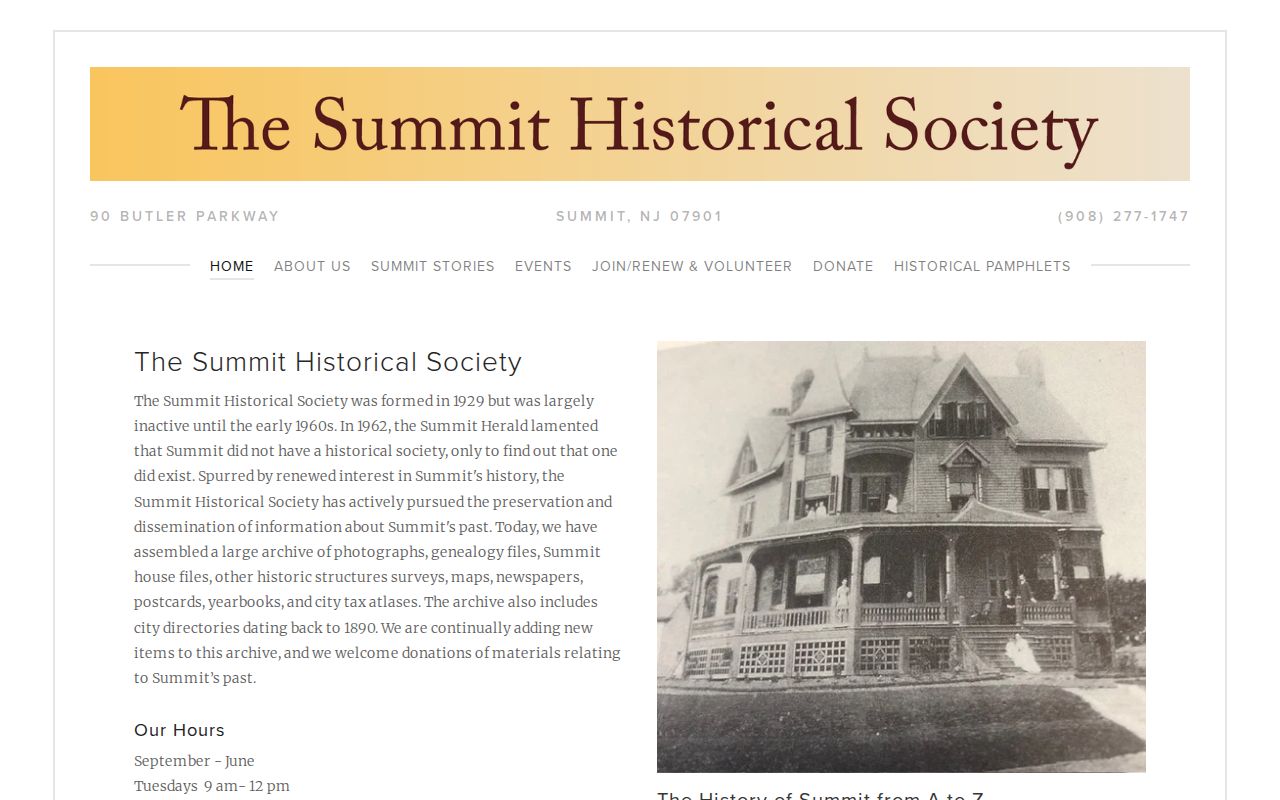
The archive is useful for locating a city directory beside house, map, or newspaper material that can test a directory entry.
House-history materials can add a place-based layer to a surname search. The Society does not advertise a separate formal house-research service in the inspected material, but its house files and pamphlets are a practical local substitute. That distinction matters: an interpretive file can suggest the next record to check, while a deed, map, or dated directory supplies the underlying evidence.
The Society pamphlets include the 1989 The Clearing brochure, a Kent Place Boulevard slide-show brochure, and History in Homes of Summit, a map with addresses and historical information revised in 1983.
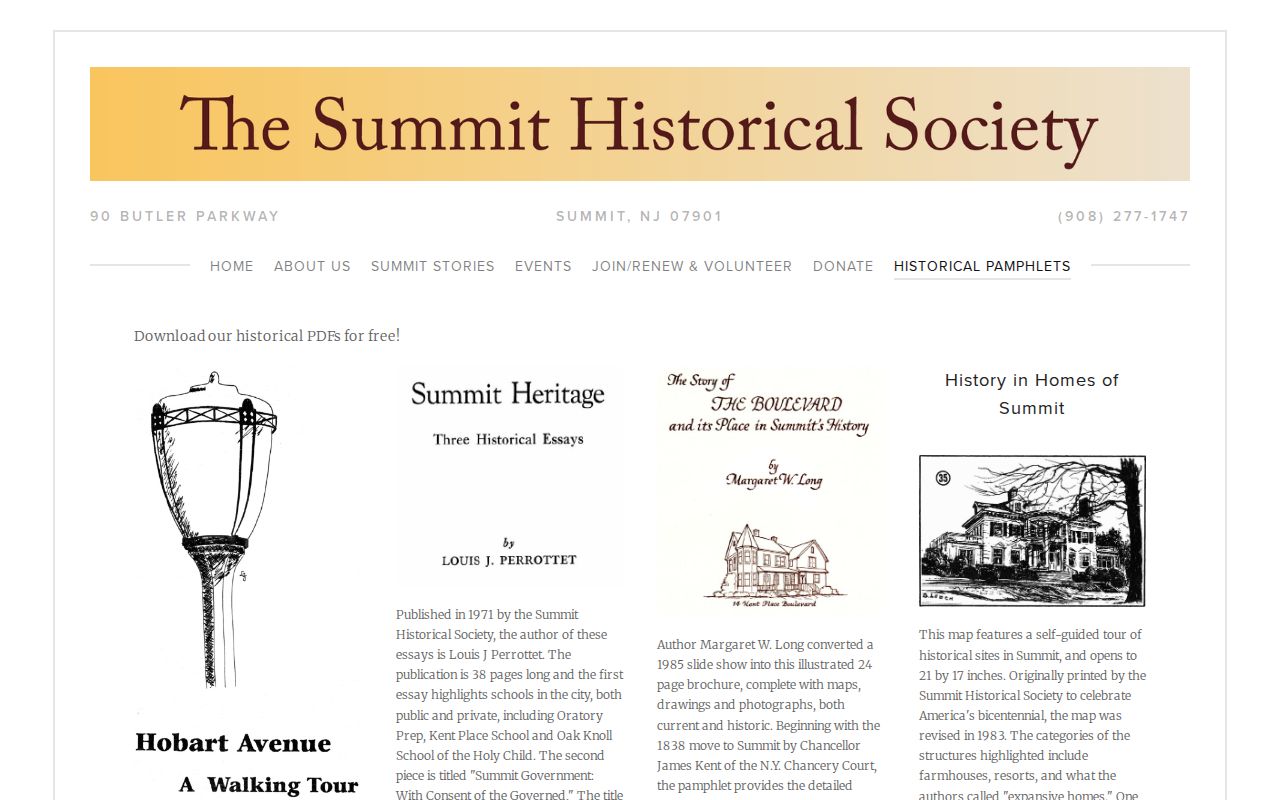
Those pamphlets can connect a street address to a historical place story, but they do not replace a check of the particular directory page and year.
Summit Library and Digital Volumes
Summit Public Library, at 75 Maple Street, is the practical first stop for scanning, computers, research help, and genealogy or history resources. Its patron information says residents and workers can obtain cards and that temporary online accounts last 30 days. The library also maintains a Summit High School Yearbooks page, though the accessible research did not establish a year-by-year run. Ask staff for the title, date range, and access rule rather than assuming a particular annual book is held.
Start with the library research links when a scan, catalog check, or staff referral is needed.
Library staff and scanning access provide a useful bridge between an online title lead and a page-level historical citation.
Union Public Library Digifind supplies free scans of regional newspapers, maps, and directories. Its 1938 Price & Lee volume identifies Summit alphabetical entries beginning on page 145 and a numerical section beginning on page 389. The book calls itself the Summit, Millburn Springfield Directory, so capture both the title page and the Summit heading. The later 1956 Price & Lee directory follows the same combined-municipality caution.
Reading a Summit City Directory Entry
A local entry commonly gives a surname and initials, a name, an occupation or business, a street address, and sometimes a telephone number. Some editions may add a spouse in parentheses, a widow notation, an owner or renter mark, an employer, or an abbreviation such as r for rear. Fields vary by publisher and year. Transcribe only what is visible in the volume, including abbreviations, rather than filling in a modern assumption.
| Name | Surname, initials, and given name as the publisher printed them |
|---|---|
| Occupation or business | A role or business association when the specific entry includes one |
| Street address | The printed number and street, which can be checked in the numerical section |
| Telephone | A number or exchange when the edition prints it |
| Marks and abbreviations | Spouse, widow, rear, owner, renter, or other notation only when defined in that volume |
- Criss-cross directory
- The address or street-order part of a directory that reverses a name search into a location search.
- Householder index
- An alphabetical arrangement that helps identify the person or household attached to the printed address.
- Abbreviation key
- The publisher's explanation of its short forms. Photograph or note it before interpreting a mark.
The numerical section is a cross-check, not a promise of full occupancy. A matching name and address in alphabetical and numerical sections is stronger than a single appearance. A publisher may have listed a business, a household, or neither, and the 1938 publisher stated that its canvassed information was not guaranteed.
Summit Directory Years in Context
Directory dates become more useful when they are set beside Summit's local record history. The milestones below identify known anchors, not a claim that every intervening directory survives. Paper books and archival collections remain important before the county's online land-record cutoff.
- 1890: The Historical Society says its Summit city-directory holdings date back to this point, although the full annual run is not mapped online.
- 1899: Summit became a city after the April 11 special charter election, a useful name and civic transition for historical searches.
- 1928-1934: NARA identifies selected Summit-area directory holdings for 1928-1930, 1932, and 1934.
- 1938 and 1956: Price & Lee regional directories are directly available as digitized, combined-municipality volumes.
- 1977: Union County's online land-record window begins June 1, so earlier ownership work still relies on the Record Room and archival sources.
Note: No authoritative source located the last printed Summit directory year, so describe an exact run only after checking the volume or catalog record.
Summit City Directories and Town Labels
Regional directory titles create a real local indexing trap. The 1938 volume covers Summit, Millburn, and Springfield, so a surname alone does not establish the municipality. Search with the page heading in view. Historical sources can also use Summit Township, Summit City, or Summit in Union County. Before 1857, the county context shifts because Union County was created from Essex County.
The safest comparison is a simple chain: directory heading, printed address, municipal map or tax-map context, then a second dated source. The City of Summit maps hub offers street, zoning, ward, and tax-map resources for that place check. A ward map supports civic geography, but it is not a household list.
Use the City boards and commissions list only as a civic-name lead.
The Tatlock Neighborhood Committee and other listed bodies can help date a civic reference, but no complete citywide neighborhood-association roster was located in official sources.
Trace Summit Households Through Directories
Use a city directory as a sequence of dated observations. Begin with the first confirmed entry, preserve the exact spelling and address, then test the next available year. Pair the observation with the closest released federal census, New Jersey state-census material, a newspaper, a tax record, a deed, or a house file. A directory should identify a lead, not settle every family relationship or move date by itself.
- Capture the title page, publisher, year, collection, page number, and municipality heading.
- Find the name in the alphabetical section and transcribe the spelling, address, occupation or business, and telephone exactly as printed.
- Check the numerical or street section for the same address when that section exists.
- Compare the nearest earlier and later directory years, noting a changed address, telephone, or surname form without assuming why it changed.
- Test the result against a census, newspaper, tax map, deed, or Historical Society house file. A modern record check can then move to the Summit resident lookup route.
A disappearance can mean a move, a death, a canvass omission, a changed spelling, or a coverage change. Newspapers and obituaries may help close a historical trail, while probate can identify an estate connection. A complete official online funeral-home or church register for Summit was not located, so request the library or Society's catalog and access rules rather than guessing.
Summit Archives Beside Directories
City sources can give an address or organization a date that a directory does not show. The City Archive supports keyword, category, and start or end date searches. Its categories include City Clerk releases, census data, planning and zoning reports, engineering, budgets, health notices, road closures, and city news. Search a name with a date, street, or board reference instead of relying on a common surname alone.
The City Clerk maintains ordinances, resolutions, agendas, and minutes, and its OPRA route can be used for an existing municipal record held by the proper custodian. Code Administration points to SDL Portal permit history and requires written inspection requests by email. Exact SDL public fields and retention years were not located in official sources. Record the document date, item number, and custodian when a municipal item is used to support a directory finding.