
Map Summit Previous Residents by Era
Different Summit sources cover different parts of an address history. The county Clerk’s modern online index is useful for the transfer chain, but the Record Room is the fallback for earlier land books. Historical directories identify published household or business entries for a particular edition, not an entire census. The Summit Historical Society reports city directories dating back to 1890, although the exact year-by-year run has not been fully mapped. Sanborn sheets and tax maps test the physical address, while permits can be a dated construction or alteration lead when the retained field is public.
| Source | Years It Covers | Where Held | What It Shows |
|---|---|---|---|
| Union County Clerk land records | Online generally June 1, 1977-current; Record Room 1857-current | County Clerk portal and Record Room | Recorded parties, transfer dates, instruments, book/page references, and legal descriptions. |
| Summit Historical Society directories | Dating back to 1890; exact run incomplete | Historical Society house and local-history collections | Published address, household, occupation, map, newspaper, or house-file leads. |
| Price & Lee directories | 1938 and 1956 digitized editions | Regional digital directory collection | Alphabetical and numerical sections for Summit, Millburn, and Springfield. |
| Federal and state census | Federal releases follow the 72-year rule; New Jersey state census 1855-1915 | Archives, library, and historical research routes | Household evidence that must be matched to the address and year. |
| Sanborn and local maps | 1893, 1898, 1903, 1921, and 1929 for documented Summit series | Princeton series and local historical leads | Street, block, building, lot, and address context, not title or occupancy. |
Start with the era that matters. A post-1977 ownership question begins in the Clerk index. A household question from a directory year begins with the exact volume and municipality heading. A much older address requires the physical place to be checked against maps and the legal description before a person is assigned to it.
Build a Summit Deed Chain
For past residents research, ownership is only one layer, but it gives the address a durable paper trail. Obtain the present block, lot, qualifier, and situs from the Summit assessor route. Then search the current owner as a grantee in the Union County Clerk land-record index. The purchase instrument normally identifies the seller and can contain a prior-reference recital. Search that prior party as a grantee to find the earlier acquisition. Repeat the sequence, keeping each instrument separate from any later directory conclusion.
- Record the current situs, block, lot, qualifier, and the date of the assessor or map source.
- Search the current owner as grantee with a narrow date range and at least one document type selected.
- Open the available deed image and transcribe the grantor, grantee, recording date, document number, book/page, legal description, and prior reference.
- Search the seller, estate, trustee, corporation, or spouse as grantee to locate the earlier transaction.
- When the online index reaches its limit, use the Clerk Record Room, staff assistance, or a certified-copy request for the earlier book and page.
The County Clerk search form documents the controls used for a backward grantor-grantee search.
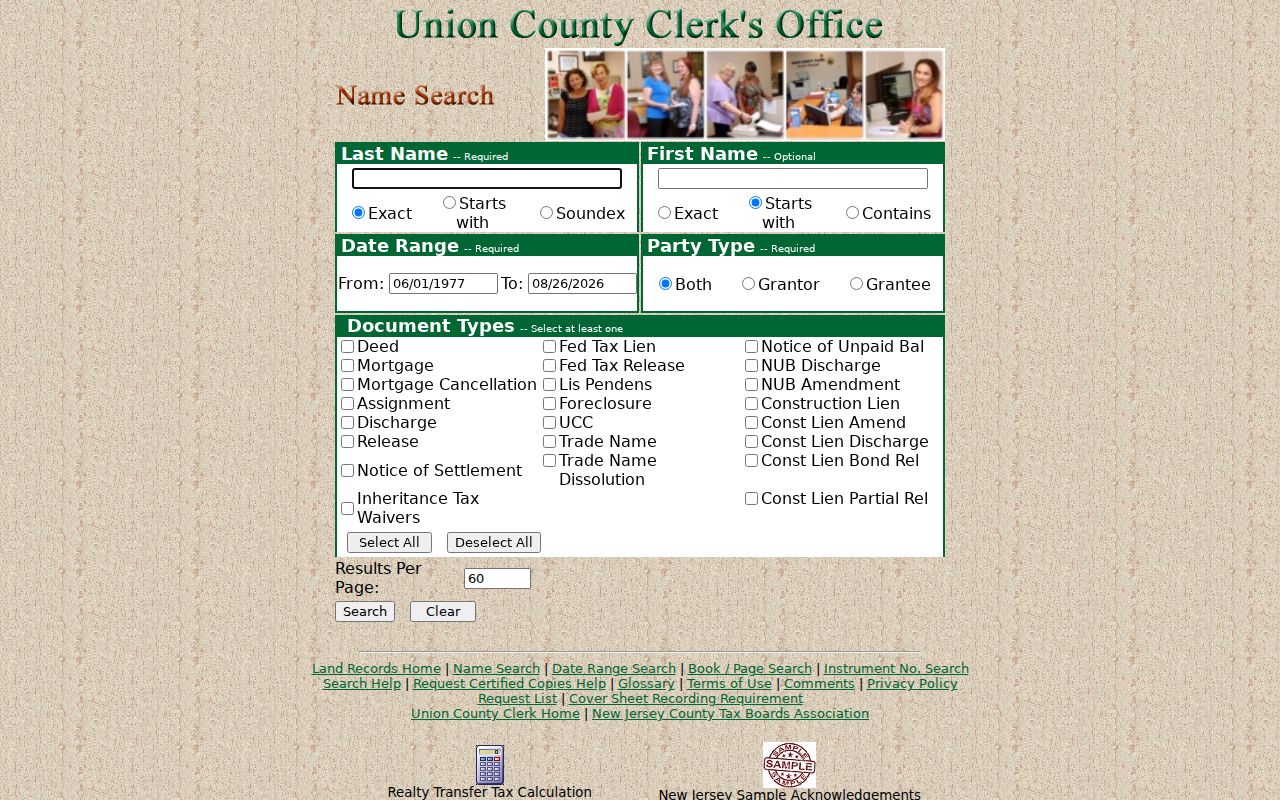
The name result is an index lead. The instrument image, when available, is where the legal description and prior-reference details must be checked.
- Grantor and grantee
- The grantor transfers or conveys an interest. The grantee receives that interest. Either may be a person, estate, trust, lender, or business.
- Chain of title
- The ordered series of recorded instruments that links a parcel’s transfers over time. It is not a complete list of people who lived there.
- Legal description
- The land description in an instrument, often using lot, subdivision, easement, or prior-deed language. It is more stable than a street label when a lot changes.
Ordinary copies are listed at $2 per page and certified copies at $8 for the first page plus $2 per additional page. Check the current Clerk schedule before submitting payment.
Pair Summit Directories With Census
Past residents often appear in a dated directory before they appear in a property chain. The 1938 Price & Lee directory combines Summit, Millburn, and Springfield and includes both alphabetical and numerical sections. Its contents identifies Summit alphabetical and numerical page ranges, but the municipality heading still needs to be checked on the actual page. The 1956 Price & Lee volume has the same combined regional character. A surname or postal label alone does not establish that a listing belongs to Summit.
- Capture the directory title page, publisher, year, and the municipality heading for the page being used.
- Search the alphabetical section for surname, initials, address, occupation or business, and telephone only as printed.
- Check the numerical section for the same street number, allowing for rear, side, or other printed abbreviations.
- Pair the directory year with the appropriate released federal census or the documented New Jersey state-census period, then test the address on a map or deed.
A matched alphabetical and numerical entry is stronger than one entry, but it remains a published snapshot. The wider collection information and reading protocol belong in the Summit Directory Book. A directory can describe an occupant, while a deed describes a recorded transfer, so both are useful without proving the same relationship.
Summit Public Library offers Ask a Librarian, scanning, computers, databases, and genealogy or history help. Its yearbook page exists, but an accessible year-run list was not located in the research, so ask staff for the title and date coverage. The Union Public Library Digifind collection is a separate regional access route for scanned newspapers, maps, and directories. Check the title page and municipality section before treating any regional volume as Summit evidence.
Note: Preserve a page image or citation for each entry, because a directory’s typography and municipality heading can change the meaning of a search result.
Use Summit House History Files
The Summit Historical Society is the best local interpretive lead when a deed chain reaches a house history rather than a simple transfer. Its collections include house files, historic-structure surveys, maps, newspapers, postcards, yearbooks, tax atlases, genealogy files, and city directories. The Society is at the Carter House archive and lists public research hours during September through June, with appointment-based access at other times. Contact or appointment research is the documented local substitute because a separate formal house-history service was not located.
The captured Historical Society page documents the Summit archive’s house-file and directory scope.
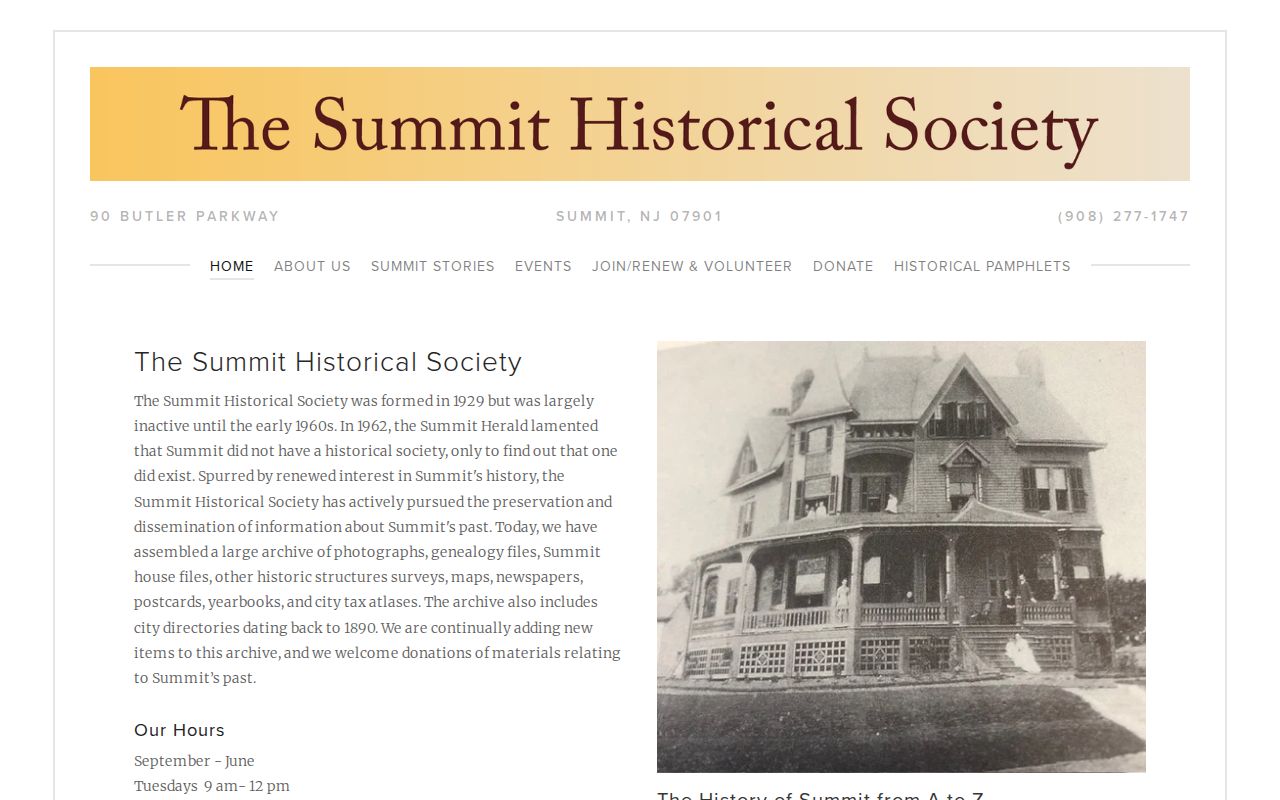
A house file can provide a useful lead, but the underlying map, directory, newspaper, or deed should be cited for a dated conclusion.
The Society’s pamphlet collection adds address-focused material. The 1989 “The Clearing” brochure includes a house-by-house walk with past owners where available. The Kent Place Boulevard material includes architecture, biographies, and past residents, while “History in Homes of Summit” combines a map with address history and an 1879 map reprint.
The captured house-history pamphlet page identifies those Summit-specific research leads.
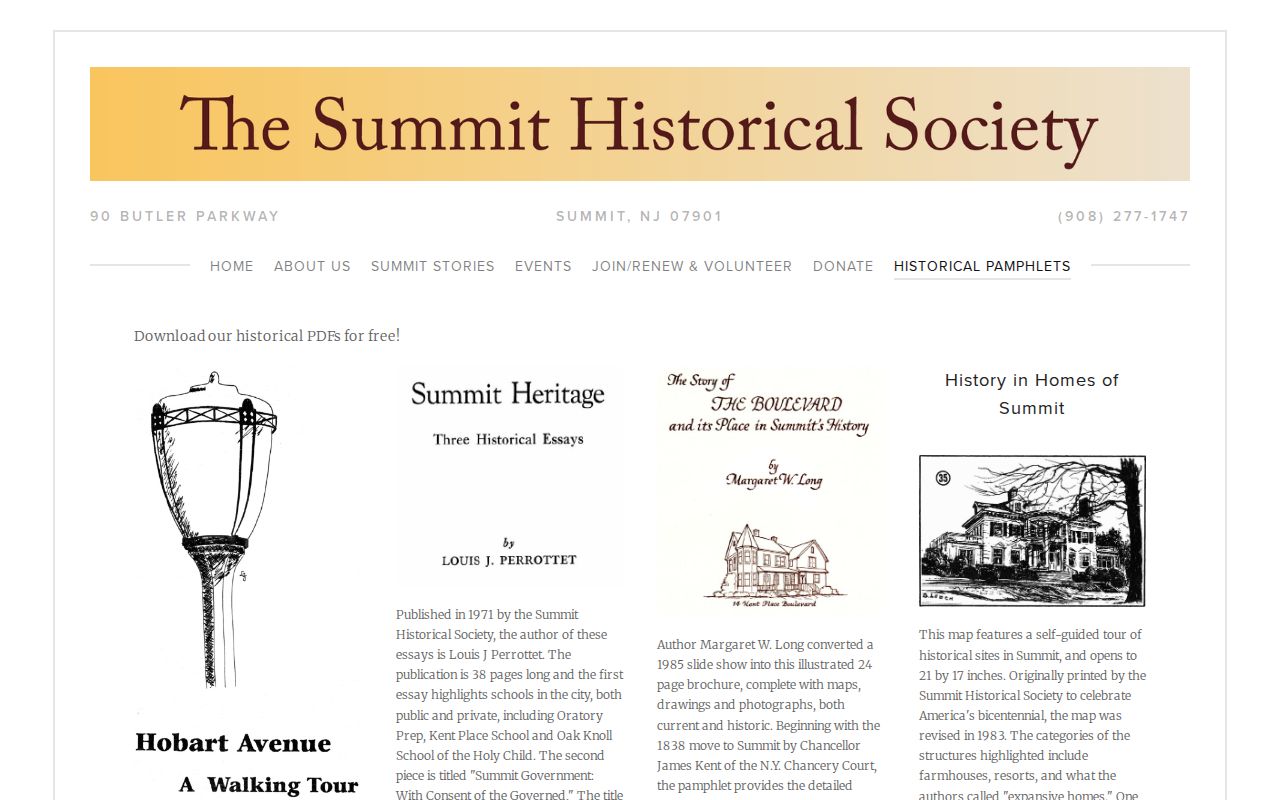
Ask whether the target street appears in a pamphlet, house file, tax atlas page, map, or photograph before requesting an onsite review.
Test Summit Address Continuity
Address continuity is a geographic question as well as a name question. Summit’s Chapter 14 preserves references to 1901 numbering ordinances and a 1909 revision, gives the Tax Assessor responsibility for principal-structure numbers, and states that previously assigned numbers remain valid. Those rules do not establish that every historic number is unchanged. Test the address through the tax map and GIS, an edition of the historic map, a directory street section, and the deed’s legal description. Search nearby numbers and street aliases when the expected number is absent.
The Princeton Sanborn Summit series provides the map-index and sheet context for this historical comparison.
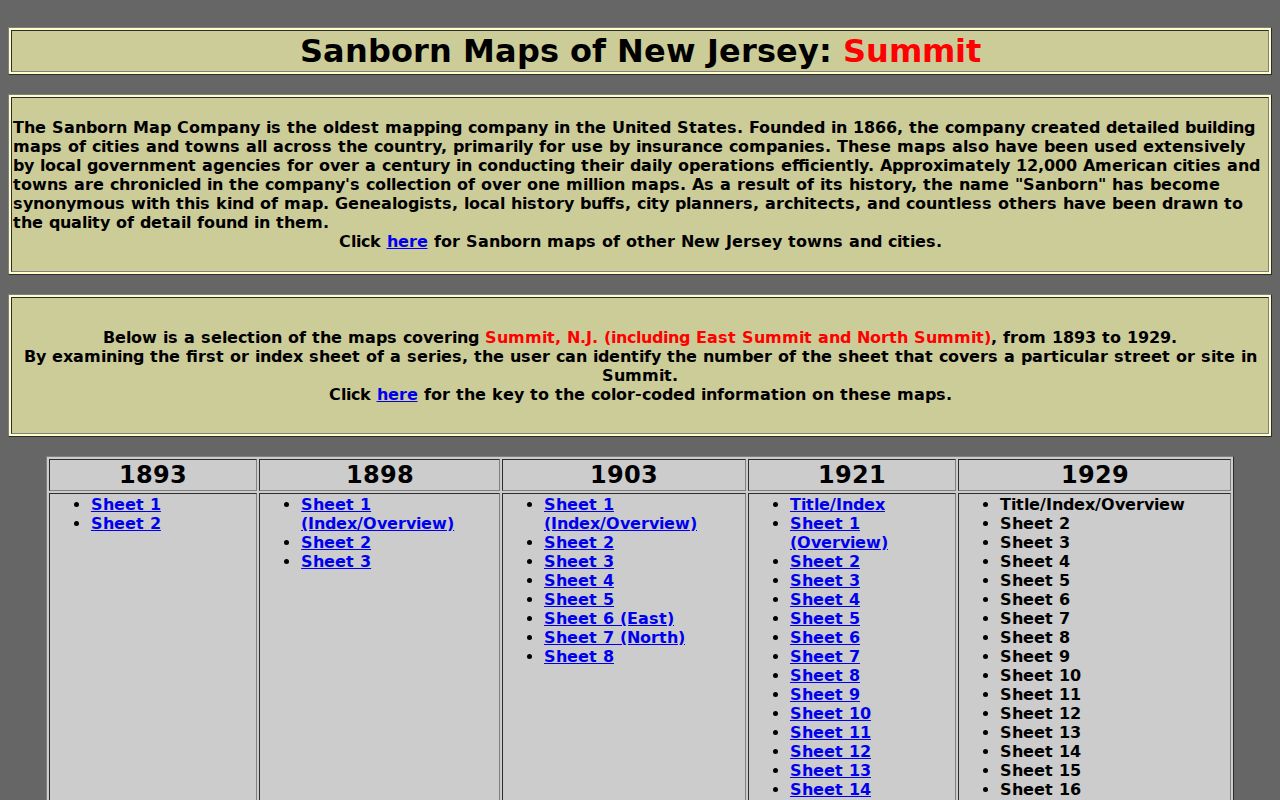
Record the map edition and sheet number, because a Sanborn sheet shows built context and street labels, not a title chain or a household roster.
The documented series includes 1893, 1898, 1903, 1921, and 1929, with coverage for East Summit and North Summit. It can show building outlines, material, use, house or block numbers, and street names. Pair it with the 2022–23 tax map and the legal description to avoid treating a stable street number as proof that the lot never changed.
Reach Summit Records Before Online
The online deed index begins generally on June 1, 1977, but the Union County Clerk says its Record Room holds land transactions from 1857 forward. That older access route matters when a prior owner is missing from the web index. Ask the Clerk for book/page or instrument guidance after extracting the earliest online legal description and prior reference. For research predating Union County’s 1857 creation, the local place history can require Essex County context. The absence of an online hit is therefore an access boundary, not proof that no transfer occurred.
| 1857 | Union County was created from Essex County, so earlier local land context may be in Essex records. |
|---|---|
| 1890 onward | The Historical Society says its directory holdings date back to 1890, though the exact annual run is incomplete. |
| 1928-1934 | NARA identifies selected Summit-area directory holdings in its 1930 city-directory context. |
| 1977 | The Clerk’s online window begins, while earlier books remain in the Record Room. |
The research did not locate a courthouse fire, flood, or catastrophic Summit or Union County land-record loss. The careful historical conclusion is simpler: paper books and archival collections remain necessary before online cutoffs.
Close a Summit Resident Trail
When a transfer is made by an estate, probate can identify the executor, estate file, or heir relationship that explains the deed party. Union County’s exact online probate-search coverage was not located, so contact the Surrogate with the decedent’s name and an approximate death year rather than substituting an unofficial index. An heir named in an estate record is not automatically a past resident. Obituaries, cemetery records, and family files can supply a date or relationship lead, but each needs a second dated source before it is tied to the address.
For a qualifying historical vital record, the New Jersey State Archives genealogy route covers state census collections from 1855 through 1915 and historical vital periods. Genealogical access generally requires that a deceased person’s birth be more than 80 years old, marriage more than 50 years old, or death more than 40 years old. Archive research is free in person in Trenton, while copying and reference work can have fees. Vital certificates are not open directory records, and a directory entry should never be used as proof of a birth, marriage, or death.
Limit Summit Previous Resident Claims
Directories are snapshots, not censuses. Deeds show parties to a conveyance, not every occupant. A map can locate a building without naming a household. Keep two labels in the research notes: record relationship and place relationship. For example, use “grantee,” “directory listing,” “house-file subject,” or “executor” unless the source itself supports the narrower claim of residence. This approach is especially important in the combined Summit, Millburn, and Springfield directories and in records with out-of-town mailing fields.
Lawful use. Use Summit previous-resident research for house history, family history, estate work, or civic context. Do not use historical records to harass, track, or expose a living person.
Cross-check each Summit conclusion with a second record type and date. A directory plus a deed, a map plus a tax record, or a house file plus a contemporaneous newspaper is stronger than any single undated claim.
Note: Preserve a missing record as an identified research gap instead of turning silence in one source into a claim about a household.