
Finding Summit Residents by Record
Summit resident research works best when the first search matches the fact you need. Use an address to begin with the Summit tax query or a parcel map. Use a recorded owner name, date range, and document type in the Union County Clerk index. Use a historical year with a city directory, newspaper, house file, or map. A court docket, vital record, business filing, and voter status each describe a narrower relationship. None is a universal list of everyone at an address.
Start with a stable item and keep the date beside it. A present-day Summit address may be standardized through the municipality lookup, while a nineteenth-century record can use Summit Township or an Essex County context. For a current property question, separate the situs, which is the physical parcel location, from an owner mailing address. For an older household question, confirm that a combined regional directory page actually belongs to Summit before recording the entry.
- Validate the address and identify the Summit municipality, street suffix, and parcel location.
- Use the tax query, MOD-IV, or GIS to save the block, lot, qualifier, and access date.
- When ownership matters, search the Clerk index by party role and a narrow date range.
- For an earlier household, compare a directory year with a map, newspaper, house file, or census substitute.
- Ask the proper custodian for an existing record when the online index does not expose it.
Note: A clear answer usually needs two independent, dated sources rather than a single current search result.
Summit Resident Records Offices
Summit is in Union County, but the county seat is Elizabeth. Municipal questions often begin at Summit City Hall, while deeds and older county land books belong with the County Clerk. The State of New Jersey routes voter status, court searches, vital-record eligibility, and many statewide records through separate systems. The offices below provide useful entry points, yet their records describe ownership, a filing role, public civic activity, or a regulated status rather than a full resident roll.
New Jersey Elections
State registration-check route
The City Clerk holds official municipal files, minutes, ordinances, resolutions, and the local OPRA route. The City Clerk, rather than a county office, is the right custodian for many local civic records. The Summit OPRA portal is useful when an existing non-exempt municipal record is not online.
Summit Parcel Search Fields
The city tax query is backed by NJ MOD-IV and documents three practical routes: street address, account number, or paired block and lot inputs. A qualifier can distinguish interests in the same parcel. Try the address as printed, then test a street suffix such as St, Rd, or Ave if the first search does not return a match. The public tax result can support a dated assessment and parcel association. It should not be read as proof that every person connected to a mailing field lived at the property.
| Summit search field | How it works | What it helps confirm |
|---|---|---|
| Street address | One search route; suffix format can matter | Candidate parcel and situs |
| Block and lot | Paired input separated by dots | Stable municipal parcel key |
| Qualifier | Optional text field | Multiple interests where shown |
| Account number | Separate search route | Tax-bill or assessment record |
The Summit Tax Assessment office page identifies the assessor and routes assessment matters to the county Board of Taxation. Its captured view appears below. The office page is a contact and access source, not a searchable resident list.
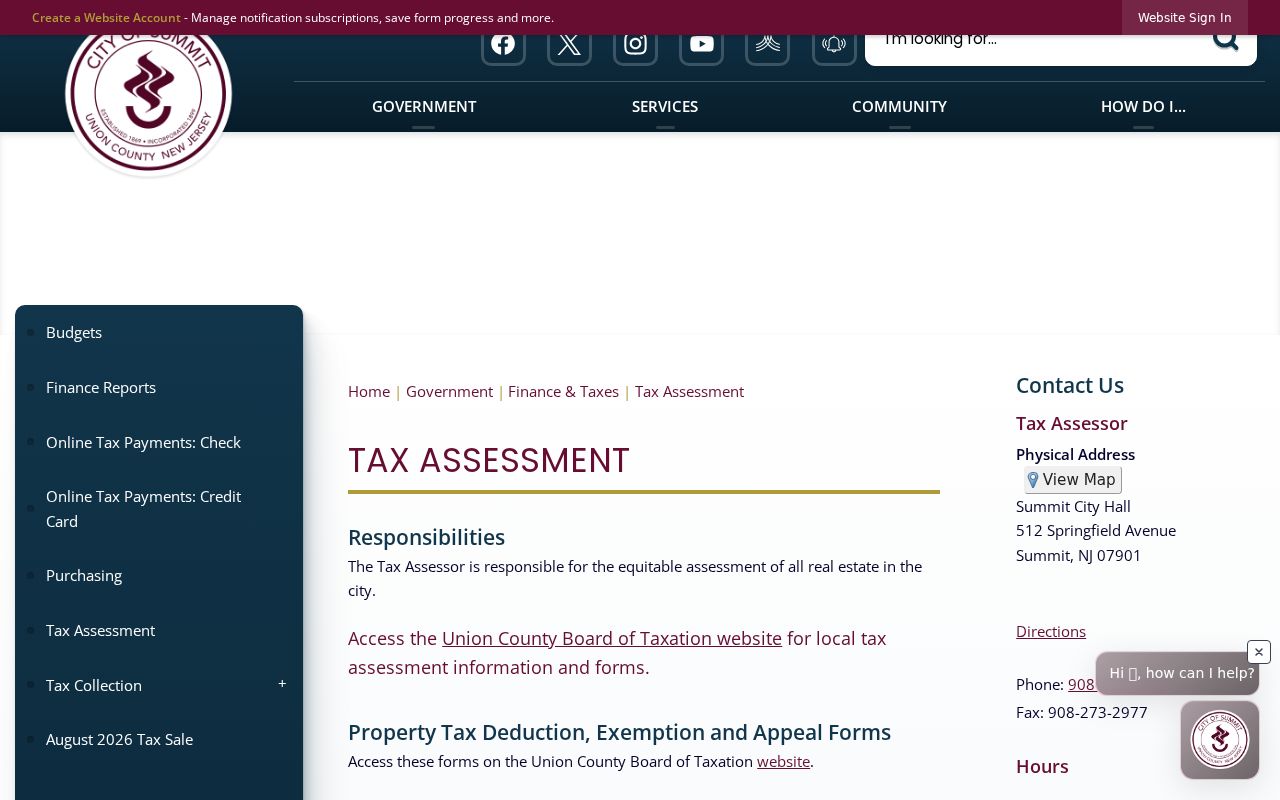
For a Summit residents directory search, use the office contact to verify the correct assessment channel, then preserve the query date with the parcel record.
- Parcel
- A tax-mapping unit identified in Summit by block, lot, and sometimes qualifier.
- Situs
- The physical property location, which can differ from an owner's mailing address.
- Index
- A finding tool that points to a record; it is not necessarily the underlying document image.
- Roll
- A list maintained for one purpose, such as assessment or registration, not a complete household census.
Summit Deed Names and Dates
The Union County Clerk name index is the main online recorded-instrument path for Summit. The online window generally begins June 1, 1977, while the Record Room holds land transactions from 1857 forward. Name search requires a last name, date range, party type, and at least one document type. Last-name matching can be Exact, Starts with, or Soundex; a first name is optional. Search both grantor and grantee roles because the same owner changes roles across a purchase and later transfer.
Its result fields can include party name and role, document type, recording date, instrument number, book/page reference, and an image control where an image is available. The legal description and block/lot linkage may be in the deed image rather than on the first search form. If the online chain ends, use the Record Room, phone the Clerk, or request a certified copy. Ordinary copies were listed at $2 per page and certified copies at $8 for the first page plus $2 for each additional page when the research was gathered; confirm the current schedule before payment.
The official name-search screen shows the required choices used to narrow a recorded-document search.
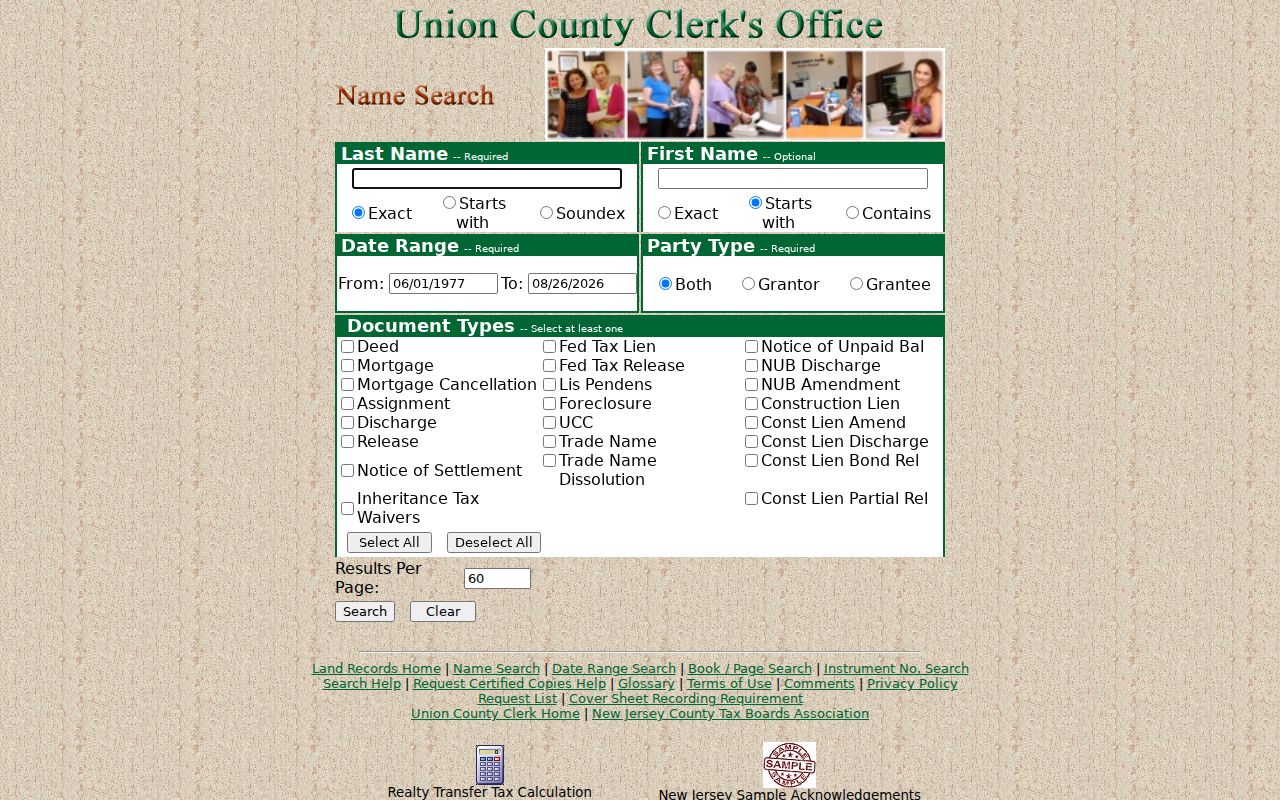
A recorded party establishes a transaction role. It does not, by itself, establish a complete household or current occupancy.
Current Summit Resident Directories
Current sources serve different tasks. The assessor and tax records can connect an owner to a parcel. The voter registration route can confirm regulated registration information, subject to statutory limits and protected-address suppression. Recorded deeds identify parties to instruments. City directories, civic lists, and community contacts identify narrower public roles. The strongest Summit residents directory result says exactly which relationship a source records and on what date.
| Summit source | Relationship shown | Custodian | Access boundary |
|---|---|---|---|
| Tax query and MOD-IV | Assessor owner, parcel, situs | Summit assessor | Owner is not occupant |
| Recorded-instrument index | Grantor, grantee, filing party | Union County Clerk | Transaction, not household |
| Registration check | Regulated voter status | NJ Elections | Protected-address rules apply |
| City staff directory | Public service contact | City of Summit | Not a resident roll |
| Community resource directory | Public organization contact | City of Summit | Not a member roster |
When the question is one person's identity rather than a property or directory entry, the Summit resident lookup route keeps court, vital, and verification sources distinct. It also explains why similar names need two matching facts before they are treated as the same person.
Note: Keep the record relationship, custodian, and date with each search result to avoid merging similar names.
Summit Voter Status Boundaries
New Jersey's registration check is a public route for a specific voter inquiry, not a street roster. Voter-list fields and limits are governed by N.J.S.A. 19:31-18, and covered-person addresses are omitted. The Union County Board of Elections is the documented local channel for election-document questions and list requests. A city ward or election-district map helps place civic geography, but it does not identify all residents in that area.
The NJ registration check returned a 403 response during the image capture. The screenshot is retained as a capture note, not as proof of an individual result.
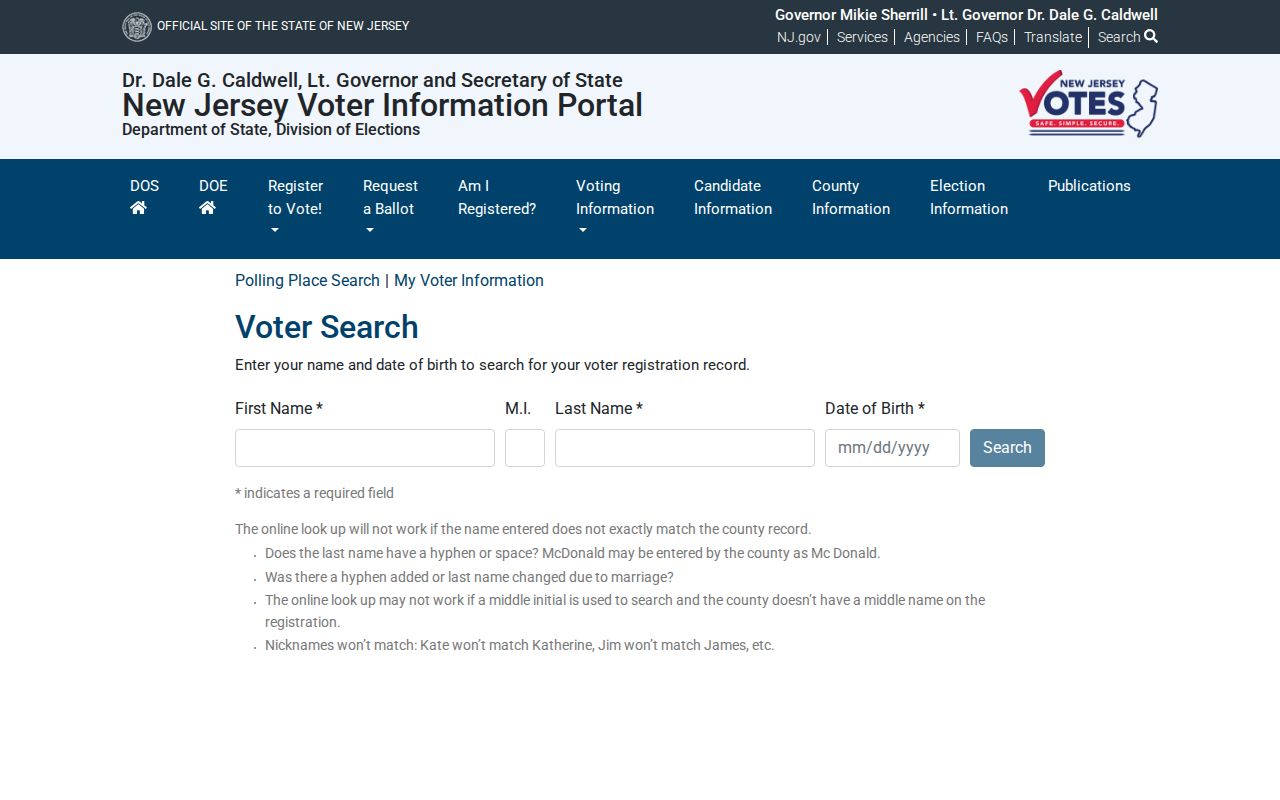
Use the state route for lawful, specific verification and ask the election office about any request that the public form cannot answer.
Summit Court and Vital Checks
The NJ Courts Find a Case menu routes civil, criminal, judgment-lien, Tax Court, and municipal matters through different court paths. A docket identifies a party, case type, docket number, and disposition metadata when public. Sealed, expunged, juvenile, and confidential material is withheld. A name alone is not enough. Add a county, division, docket type, date, or other independent identifier before treating two records as a match.
The official court search menu captured for Summit research is shown below. It provides routing, not a blanket right to images or confidential filings.
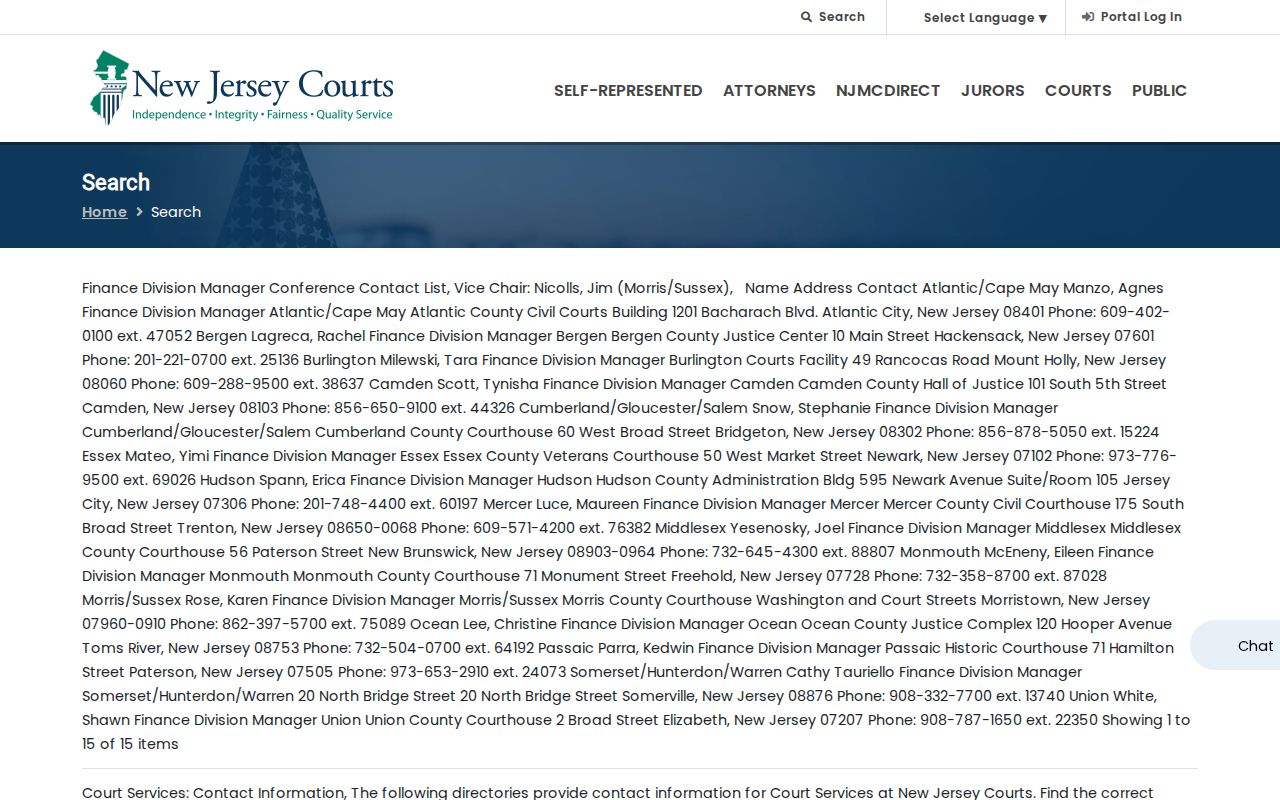
For birth, death, marriage, or civil-union records, Summit Health & Vital Statistics and NJ DOH have eligibility and identity requirements. Current certificates are not a public online name search. Older genealogical requests follow age and death thresholds through the State Archives or health department.
Summit Maps Before a Search
The City maps hub brings together street, zoning, ward, and 2022-23 tax-map resources. It is a useful first check when a postal address, municipal line, or street label is uncertain. The tax map supplies fixed-date block and lot geography. The GIS map can add current parcel tools and aerial layers. A deed's legal description remains the better source for a title-chain conclusion.
The city maps hub pictured here is a practical source for choosing the right geographic layer before a Summit residents directory search.
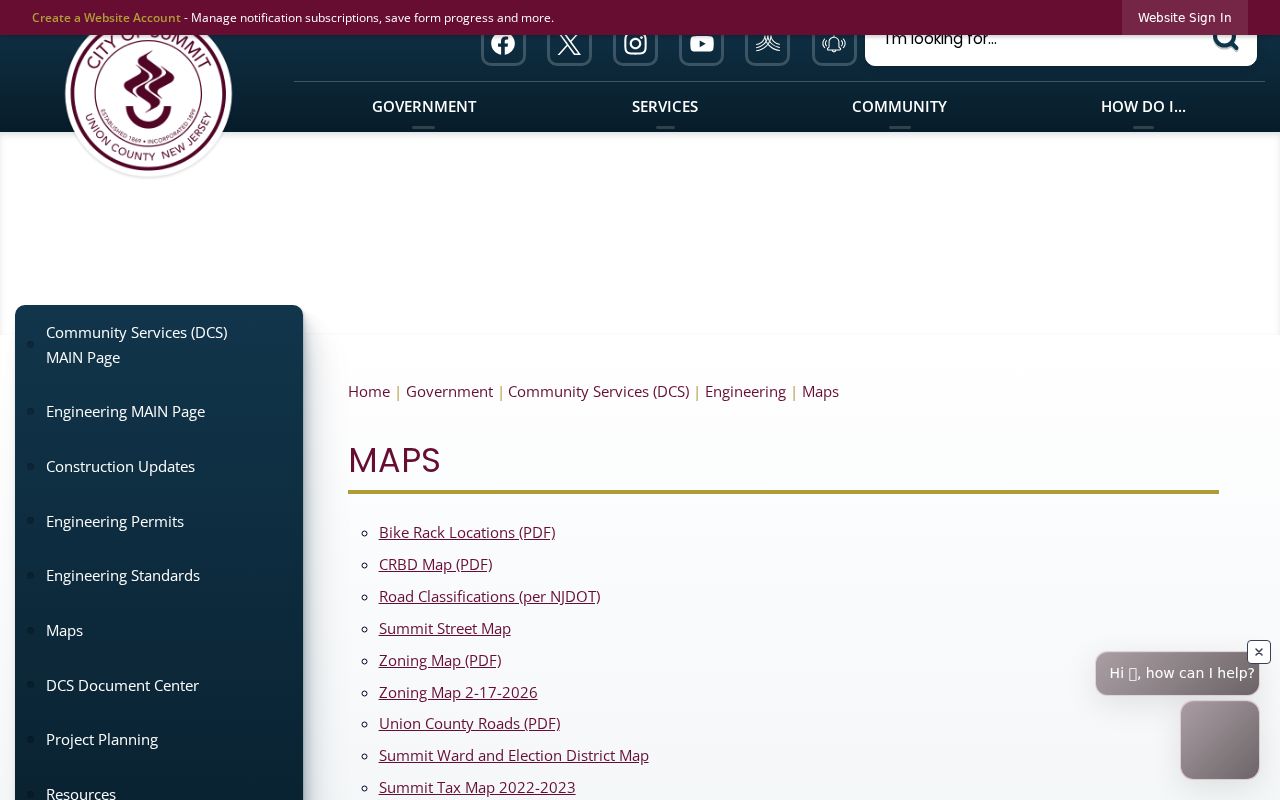
Ward and zoning layers provide context. They do not convert a map label into proof of residence or ownership.
Historical Summit Resident Directories
For past residents, Summit has a strong local archive stack. The Summit Historical Society says its city directories date back to 1890, though the exact year-by-year run was not mapped in the reviewed sources. Digitized Price & Lee regional volumes are directly identified for 1938 and 1956, and the regional collection is described as 1942-2012. The 1938 title combines Summit, Millburn, and Springfield, so the municipality heading must be visible before an entry is assigned to Summit.
The Society also holds house files, maps, newspapers, tax atlases, photographs, and yearbooks. Summit Public Library offers research help, scanning, computers, and local history resources. The Summit Directory Book details how to read the alphabetical and numerical sections without mistaking a publisher's snapshot for a census.
The Summit Historical Society site shows the archive source for historical resident and house research.

An appointment or catalog question can reveal a house file or directory volume that has no standalone public index.
Summit GIS and Parcel Context
Union County GISWeb documents owner-name, parcel, address, subdivision, and street searches, plus Select, Identify, measurement, print, aerial, and CSV-export tools. The published domain ends in nc.gov even though the research target is New Jersey, so verify the route from an official county page before relying on it. If it is unavailable, use the City maps hub, MOD-IV, the state property-transparency map, or a bounded records request.
The captured GIS screen shows the parcel-oriented tools used to compare a Summit address with map context.
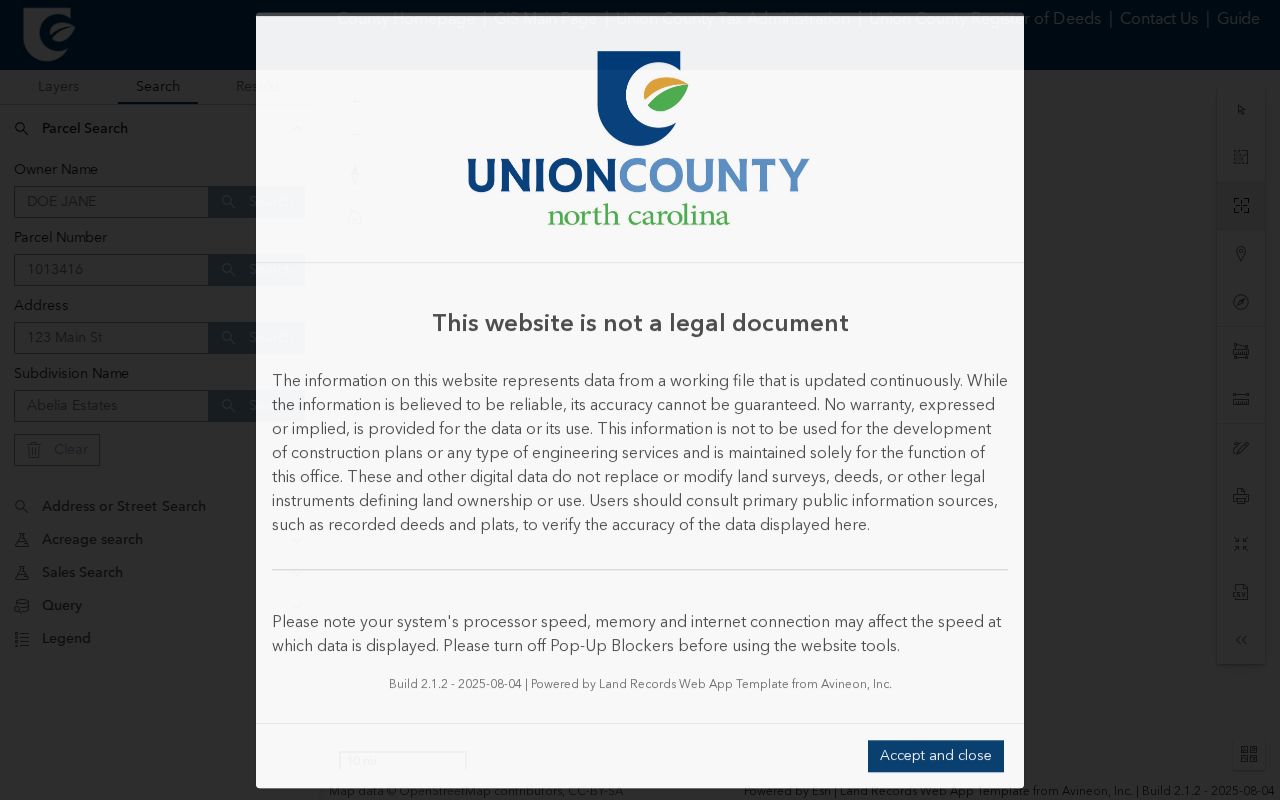
Record map scale, aerial date, and parcel ID. Geometry can guide research, but it is not a deed image or proof of a household.
Summit Record History and Aliases
Summit became a city after an April 11, 1899 charter election, while Union County was created from Essex County in 1857. Older research can therefore require Summit Township, an older place label, or Essex County material. The city code preserves street-numbering ordinances from 1901 and a 1909 revision. It validates previously assigned numbers, but it does not prove that every historical address remained unchanged. Compare a map, directory, tax record, and deed before matching an old number to a current parcel.
Sanborn editions for 1893, 1898, 1903, 1921, and 1929 add building and street context. Their index sheets and edition dates matter. A Sanborn map is neither a resident list nor a title document, but it can bridge a directory address to the correct historic block.
Note: Search Summit, Summit Township, and the combined regional directory label separately when an older record does not appear.
Summit Copy Fees and Fraud Alerts
Copies are different from a free index search. The County Clerk's posted schedule lists ordinary copies at $2 per page and certified copies at $8 for the first page plus $2 for each additional page. The county also warns about a private property-history mailer. Its official online post-1977 history and staff assistance are free, while older books are in Elizabeth. Confirm a current fee before placing any order because schedules and recording rules change.
The County Clerk fee schedule capture helps distinguish an access charge from a third-party solicitation.
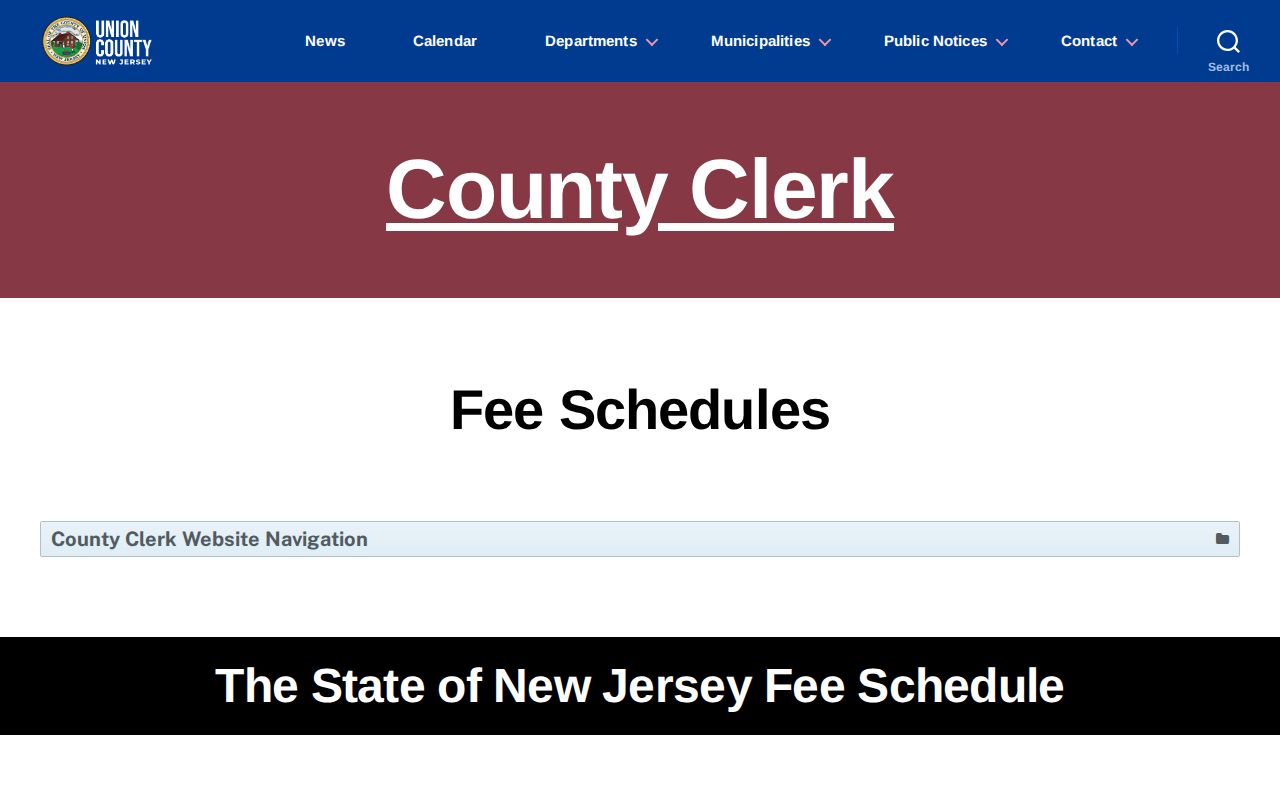
Union County continued its free property-fraud alert program in March 2025. An alert cannot prevent fraud, so verify a suspicious document in the official index before taking action.
Summit Records Requests and Logs
Some Summit records are not searchable online, and an unanswered portal search is not proof that the record does not exist. The City Archive supports keyword, category, and date-range searching for municipal material such as planning and zoning reports, engineering records, health notices, City Clerk releases, and board-related documents. The DCS Document Center adds permits, zoning certificates, development applications, and 200-foot owner-list material. For a record that is held but not posted, ask the City Clerk or the correct department for the existing record, a defined date range, and accepted redactions.
New Jersey's Open Public Records Act, N.J.S.A. 47:1A-1 et seq., requires a written request to the proper custodian. A verbal request is not an OPRA request. Keep a small access log with the URL, custodian, exact request, date, fee estimate, response date, exemption if any, and next step. The Summit City Archive, a library appointment, a Clerk Record Room visit, and a targeted written request are practical fallback channels when a name or address is not in a public index.
Note: Request an existing record or defined series, then retain the custodian response and any redaction decision with the search notes.